


A reserve is money set aside for the capital items that will eventually need replacing, and it is usually calculated one property at a time as a percentage of rent. That works until you own several properties bought around the same time in the same market, at which point the systems age together and the failures arrive in clusters rather than on average. The portfolio risk is the correlation between the properties, and the percentage of rent rules do not measure it very well.
Almost every rental owner knows they should be setting money aside. Most have a rough figure in mind, usually five or ten percent of rent, and most have never checked it against what the house will actually need.
The checking is worth doing, because on a lot of properties the rule of thumb is low. And the more properties you own, the less that per property estimate tells you about the risk you are actually carrying.
A reserve is not an expense
This is a good place to start, because it changes how the number should feel to you.
When you set aside $200 a month for a future roof, you have not actually spent $200. You have moved it from one of your pockets to another. The money is still yours and it is still on your balance sheet.
Which means skipping the reserve does not make you richer. It makes the monthly figure look better while creating a liability you have not planned for. That roof will need to be replaced either way. The only question is whether the money has been set aside for when it arrives or whether you borrow it at short notice, which is the expensive version.
That is also why a calculator treating reserves as an expense line is slightly misleading. It is certainly the right thing to subtract when you are working out what the property really produces, but it is wrong to think that money is gone.
Repairs and capital expenses are different things
Consider that these two categories behave differently in every way that will matter to you.
A repair keeps the property in working order. The faucet leaks, the garbage disposal fails, a window breaks. It happens this year, it costs what it costs, and it is generally deductible in the year you pay it.
A capital expense replaces or improves something with a long life. The roof, the furnace, the full flooring replacement, a kitchen remodel. It is generally not deductible in the year you spend it. It gets added to your basis and depreciated over time.
The tax difference is real. A deductible repair can reduce this year's taxable income. A capital improvement is generally added to basis and recovered through depreciation over time. That depreciation reduces taxable income while you own the property and also reduces the adjusted basis used when you sell. The $12,000 roof in the capital gains worked example was treated as an improvement and depreciated rather than deducted all at once.
The line between the repairs and capital expenses is not always clear, and the classification is a tax question rather than your own judgment call. It is best to ask your tax advisor rather than deciding it yourself, because getting it wrong in either direction costs money.
Working out what one house actually needs
One common method is the percentage of rent method. It is a fast way to arrive at a calculation but for sure it is just a guess. The component method takes twenty minutes and is much more defensible.
Begin by listing the major items the house needs, estimate what each costs to replace, estimate how long each lasts, and divide. That is your annual accrual for each item.
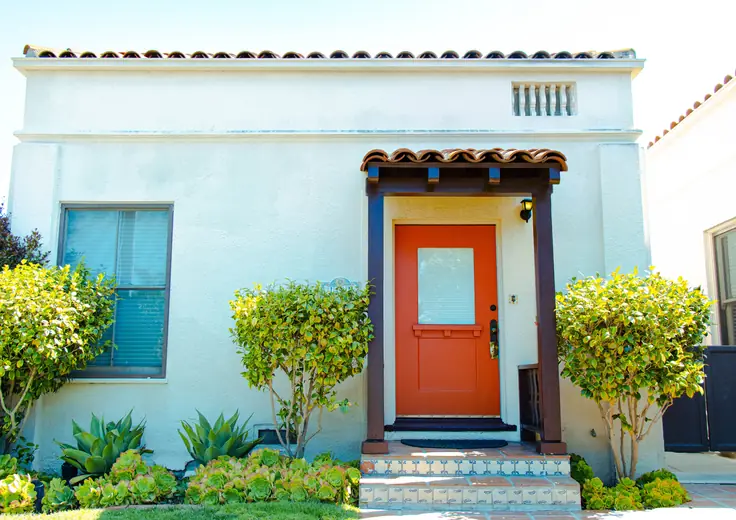
When we run it on the house used throughout this site, a property bought for $187,500 renting for $1,800 a month:
The above costs and useful lives are illustrative. Yours will depend on the house, the climate, the quality of what is already there, and what contractors charge where you are.
The above calculation results in $213 a month, and it is about 11.8 percent of the rent.
Now compare that result to the rules of thumb. Five percent of rent would be $1,080 a year. Ten percent would be $2,160. Both are below what this house actually accrues, and the five percent version is short by more than half.
It is worth being honest about how we are calculating this to avoid any misconceptions. The worked examples across this site assume operating costs, vacancy, and reserves take 40 percent of rent, which on this house is $8,640. If reserves alone are $2,554, they are consuming nearly 30 percent of that budget before taxes, insurance, maintenance, vacancy or management take anything. That assumption is defensible on a well maintained property. On an older one it is tight, and it is one of the first places a working number should be replaced with a real one.
Where the per property method can mislead
Every calculation above treats each house on its own. Across a portfolio, the current age of the components and the reserve balance already accumulated against them matter just as much as the annual calculation.
Owners tend to buy several properties over a short stretch, in one market, often of a similar age and construction. Ten houses built in the same decade, with systems that were roughly the same age at purchase, should not be expected to fail on a smooth average. Several may fail within the same few years.
Take eight of the same houses in the example above. The total annual reserve calculation is $20,432 across the portfolio, including $3,840 for the roofs.
Now suppose those houses were purchased with roofs already about twenty years old, but the owner started with no accumulated roof reserve. Five of the eight roofs reach the end of their lives during the next four years.
- Roof accrual over four years: $15,360
- Roofs actually needed: five at $12,000, so $60,000
- Shortfall: $44,640
Nothing unusual happened. There was no storm or neglect. The $480 annual calculation for each roof was reasonable across its full twenty-five-year life, but beginning at zero when the roofs were already twenty years old created the shortfall.
That is the portfolio risk. A component method must account for current age, remaining life, and the reserve balance that should already exist. It must also show whether several large replacements could arrive close together.
Pooling helps, but only when the timing is actually spread
In our experience, reserves are one of several costs that get dropped from an analysis because they have not happened yet, and we will provide the rest of the list in a future article.
The usual advice is to hold one reserve fund across the portfolio instead of separate accounts per house, and we believe that advice is right. A single pool is more efficient, because one property's roof can be paid from money accrued against another property that has not needed anything yet.
But pooling only smooths what is actually staggered. It does nothing about the correlation between properties we discussed above. If the systems are the same age, the pool empties at the same moment each account would have.
So the useful question for a portfolio is not how much am I setting aside. It is when is this all going to land, and can I absorb it if two or three arrive together.
That question has a real answer, and it is not a percentage. It is you listing out the major components across every property with an approximate age. We recognize this is tedious to build the first time, but long term it takes a minimal amount of time to maintain. It can be the difference between knowing your exposure and hoping things just work out.
Age matters more than count
A portfolio of ten houses is not a meaningful description of what you own.
Ten properties built during the same period with original systems may have several relatively quiet years followed by a period heavy in large out of pocket repairs. Ten properties from the 1960s that have already been through two rounds of replacement are in a different position, and the ones that have never been updated are in the worst position of them all.
The number of properties and rent you charge tells you something about the portfolio but the age of each property and the future likely expenses tell you more.
This is the same problem as counting doors. The number is easy to say and it hides everything that decides the outcome.
Where the money has to sit
There is one constraint that very often gets overlooked. A reserve only works if you have immediate access to it.
Equity sitting inside another property is not the same as a liquid reserve. It cannot pay a contractor until you refinance, draw on a line of credit, or sell. All three take time, cost money, and depend on rates and lender terms when the money is needed. That need often arrives at the worst possible time.
That is one of the real arguments in the decision about whether to pay off a rental. A payoff raises cash flow and lowers debt risk on that property, but it also converts liquid money into one of its least liquid forms. If the payoff leaves you unable to handle a roof, a furnace, and a long vacancy at the same time, it has not reduced risk. It has just moved it somewhere that is harder to see.
There is one more wrinkle worth knowing. Money is not deductible merely because you set it aside. Once it is spent, the tax treatment depends on whether the work qualifies as a repair or must be capitalized and depreciated, so your reserve calculation and your tax return will not necessarily agree. This is normal, and it is part of why cash flow and taxable profit are different numbers.
What under-reserving actually costs
It costs nothing at all, for years, and then it costs a great deal all at once.
The pattern is consistent in our experience. The monthly figures look healthy because a real cost is missing from them. Landlords make real long-term decisions off those figures, often including buying another property, which adds another set of systems to the pile. Then something fails, the money is not there, and the fix is a credit card, a hard money draw, or a hurried refinance at whatever rate is available that month.
The repair was always going to happen. The financing cost was optional and it was created simply for lack of planning.
There is a portfolio version of the same thing. A portfolio that produces good income and cannot absorb one roof is not a strong portfolio. It is a fragile one that has not been tested yet, and the income figure that most landlords focus on does not tell them which they have.
The number this is really about
Reserves look like a bookkeeping detail and they are actually a measure of how resilent your portfolio really is.
Can the portfolio take a bad year? Not an average year with an average repair, but the year two furnaces and a roof all need to be replaced between January and June while one unit turns over and you cannot find a new renter. If the answer is yes, the income figure means something. If the answer is no, the income figure is describing a version of the portfolio that only exists when nothing breaks.
Which is the same thing as knowing where the portfolio actually stands, on real costs rather than convenient ones, and whether what it produces is enough to reach what you are building it for with something left over.
Novarif is being built to show rental property owners what the portfolio produces after every real cost, including the ones that have not happened yet, and whether it can absorb a bad year without derailing the goal. Join early access to run your own numbers.